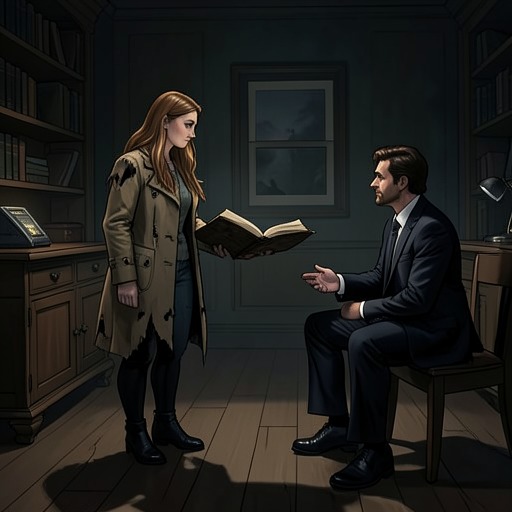
Amy Hide—Michael Shane
Other PeopleAmy Hide and Michael Shane’s former relationship is remembered as a first love that was passionate, damaging, and difficult to leave behind. Michael describes heartbreak and Amy’s capacity to undermine intimacy; the narrator then revises key parts of his account, revealing how memory and self-protection shape the story he tells. Years later, Amy still calls him an old flame, while Michael’s recollection remains tied to the end of their relationship and to a change in his life that, according to the narrator, proved lasting.
Recognition and the First Love
Mary Lamb approaches Michael because she says she is Amy’s cousin and wants to talk about her. Michael readily welcomes the subject: he calls Amy his favorite topic, despite claiming he has not thought about her for at least ten minutes. When he turns to Mary, he sees a resemblance strong enough to interrupt his attention to a telephone conversation. He tells her she is very like Amy, then qualifies the comparison: their eye color is the same, but their eyes differ, and Amy’s hands were white and idle in a way Mary’s are not. The comparison establishes that Michael’s memory of Amy is immediate and highly particular, while also distinguishing the living woman before him from the person he recalls.
Michael identifies Amy as his first love in every sense and says that she broke his heart. He presents the pain as settled, telling Mary that he thinks it is fixed now, but does not describe the relationship as simply unhappy. He remembers Amy as funny, exciting, expressive, wild, and passionate, and pauses in evident reverie over those qualities. His account holds affection and hurt together: the relationship remains emotionally vivid even as he insists that its wound has healed. Mary, who has no personal knowledge of the history he is recounting, listens as he speaks with the familiarity of someone who has told parts of the story many times.
Intimacy, Insecurity, and Conflict
Michael attributes Amy’s destructive behavior to insecurity. In his view, when she began to care deeply for someone, some part of her turned against that person or against herself, leading her to damage the attachment and humiliate herself. This is his interpretation, not an account independently confirmed by Amy in the scene. It nevertheless gives shape to the relationship as he remembers it: affection did not reassure her or stabilize their connection, but became entangled with actions that threatened it.
He describes a range of conduct that he considered harmful, including taunting him, being unfaithful, drinking, and behaving viciously. He also recalls that Amy hit him once while he was asleep. The details convey a relationship in which emotional closeness coexisted with unpredictable conflict; they do not turn Michael’s description into a complete or neutral record of Amy’s motives. His emphasis falls on the contrast between her intelligence and appearance, which he says she possessed in abundance, and the insecurity he believed lay beneath them.
The most elaborate example in Michael’s story concerns a play he had spent the year writing while they were together. Its title was The Man Who Had Everything. During a stay alone together at a borrowed country cottage, Michael was reading and revising the script. Amy locked herself in his study, where an open fire was burning, and told him through the door that she would destroy the manuscript. He had no copy. As he pleaded outside, she read passages aloud in a distorted imitation of his voice; smoke and ash came from beneath the door. The episode extended for about an hour before she let him in. He found the grate full and the room difficult to see through, while Amy pointed at him and giggled.
The Play and the Breakup
Michael says the apparent destruction led to a prolonged fistfight. When they were exhausted, he was lying down and crying, and Amy revealed that she had not burned the play: the manuscript was in another room, and she had burned blank paper instead. Michael recalls feeling happier than he had ever felt. They got drunk, went to bed, and ran naked around the house; he remembers the episode as an ecstatic return to the sense that he was living intensely. That happiness did not settle the meaning of what had happened. He later concluded that Amy must have known the play by heart and hated it by heart, and says that he burned it a week later. He places the end of their relationship around this period.
The narrator explicitly corrects Michael’s version. The play was not merely something he chose to burn a week later: although it was his decision in the immediate sense, Amy made him do it, and he did not want to. The narrator also judges the play, described as conscientious and mediocre rather than especially bad. This correction changes the balance of the anecdote. Michael’s telling emphasizes the false alarm, reconciliation, and later realization; the narrator restores Amy’s role in the play’s actual destruction and makes clear that the brief relief did not erase her power over the outcome. The episode thus becomes more than an eccentric quarrel: it is a remembered contest over Michael’s work, followed by a reconciliation whose intensity coexists with pressure and resentment.
Aftermath and Retrospective Meaning
Michael tells Mary that after Amy he thought he was going queer for about a year. The narrator intervenes to say this is misleading: Michael did become queer and never returned to not being queer. The text therefore distinguishes Michael’s own account of a temporary aftermath from the narrator’s claim that the change endured. It does not establish that Amy deliberately caused this change; rather, the narrator presents Michael’s relationship with her as the point after which his life took a lasting direction. Michael’s comparison of other women to transparent figures captures his reported inability, for a time, to experience another relationship as comparable to this first one.
The later recollection confirms that Amy also retained the relationship as part of her history. In the domestic routine she shares with Prince, she hesitates before identifying Michael as an old flame. She then reports that he had said he thought he was going queer after her. Prince begins to repeat the narrator’s correction—that Michael was right and did become queer—but interrupts himself when his glass nearly slips. This recurrence links Michael’s account in Mary’s visit to Amy’s later life without supplying a new version of the events between them. Their bond persists as a story each can refer to, but the two accounts are not symmetrical: Michael narrates the heartbreak and the play, while Amy’s later reference is brief and filtered through her conversation with Prince. Together, those recollections present their relationship as an attachment whose intensity survived its ending, while leaving its central memories open to disagreement and correction.